

Let’s get this out of the way first:
Convincing someone to buy your product with copywriting isn’t about manipulating or tricking them.
I notice a lot of people have this misconception (worryingly, many of them are copywriters).
The best copywriting comes from a place of empathy.
- Understand your audience’s needs
- Craft a compelling pitch
- Build genuine trust
- Exchange value
There’s no manipulation.
Understanding basic concepts of persuasion helps you clearly showcase your value to potential buyers, but it’s not an underhanded trick.
Understanding the Psychology of Persuasion
Grasping the underlying principles of persuasion will help you convince someone to buy your product.
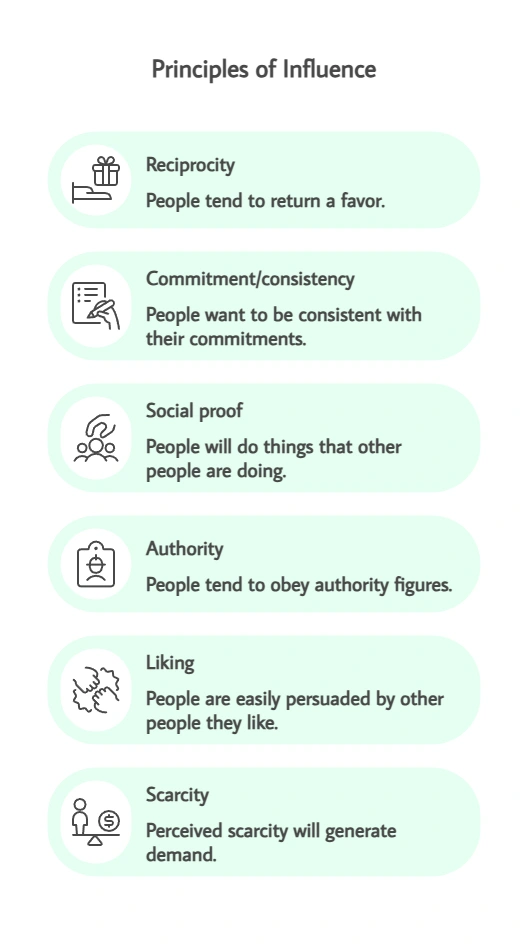
In his bestselling book, Influence: The Psychology of Persuasion, renowned Psychologist Robert Cialdini identified six key principles of influence.
- Reciprocity
- Commitment/consistency
- Social proof
- Authority
- Liking
- Scarcity
Applying these to your business copy helps convince people to buy your product.
1. Reciprocity
The principle of reciprocity suggests that people are more likely to say “yes” if you give them something valuable first.
In a sales context, this could mean offering…
- A free trial
- A valuable resource
- A personalised consultation
…before asking for the sale.
Giving value before you ask creates a sense of obligation and increases the likelihood of a positive response.
2. Commitment/Consistency
Unconsciously, people want consistency in their actions, beliefs and commitments. You act in line with your previous choices.
Part of this is small initial commitments that lead to larger ones later.
But how can you apply it to convince someone to buy your product with copywriting?
Businesses do it all the time…
Say you’re a personal trainer. Your high-ticket offer is $5000 per month.
Getting people to pay that straight-up on your website is a big ask.
You can use the commitment/consistency principle, though. Breaking it up into smaller commitments could go something like this:
- Sign up for a free training session
- Buy a 4-week program (one weekly check-in)
- Get a bronze-level membership ($1000 per month)
- Sign up for the platinum package ($5000 per month)
This is just a quick example, but you get the idea. A small commitment gets the ball rolling, gives potential customers low-risk value and better positions you to sell your high-ticket offer.
3. Social Proof
People look to others for guidance when making buying decisions.
How many reviews do you read before buying something?
I read heaps before making a decision, probably too many. But I’m not alone in trusting reviews.
According to a BrightLocal study, 50% of consumers trust reviews as much as personal recommendations from friends and family.
Including social proof in copywriting helps you convince people to buy.
Use customer testimonials that show how others have benefited from your product. The more you can point to, the better.
They tell a story, showing a successful outcome for others. This increases the chances they’ll invest in it themselves.
4. Authority
People tend to trust and follow the lead of those they perceive as experts or authority figures.
Establishing industry authority in your copywriting helps build trust. And people buy from businesses they trust.
- Highlight your expertise
- Display credentials
- Show recognition
Share insights and knowledge about your industry. Include any certifications or awards on your website. Display results.
- Show a deep understanding of your customer’s challenges
- Address their problems with empathy
- Prove your product can help
5. Liking
Buying from people we like is easier.
A few business coaches on LinkedIn rub me the wrong way. Their services could probably help me. They’ll have a tough time convincing me to buy from them, though, because I don’t like them.
These feelings are conscious. But a lot of the time, “liking” is subconscious, and we’re unaware of it.
This is one of the reasons the best copywriting is empathetic. Because people like being seen and understood.
And I’m not talking about the fake empathy I see all the time in copywriting:
“Is your back sore from driving? We’ve been there and feel your pain.”
Yeah, right.
I’m on about showing genuine empathy. The type of empathy you get from knowing and understanding your potential customers inside out.
You don’t need to fake it.
People immediately notice that you understand them, even if it’s subconscious. You build rapport and make it easier to convince them to buy.
It’s not manipulation or trickery, because you can solve their problem, and they need your help.
6. Scarcity
Supply and demand, baby.
Here in Australia, residential construction isn’t keeping up with population growth. You’ll see 100s of people showing up for a house auction. Frankly, some shitboxes are being sold for ridiculous amounts.
This is scarcity in action. Buyers are prompted to act, even though house prices are through the roof (no pun intended).
You see businesses use scarcity all the time. They display messages such as “only 1 left at this price” in the example below.
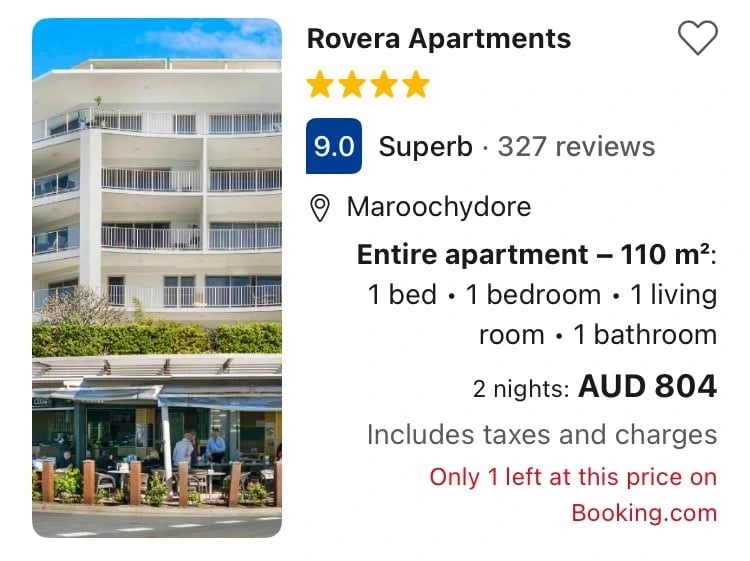
Of course, people use fake scarcity all the time. Just go on social media, and you’ll see scarcity used everywhere (most of it lies).
That’s trickery and manipulation.
You snap up a webinar seat because there’s “only 1 left” and attend with 3 other people 🤔
5 Techniques for Crafting Compelling Copy
Understanding the psychology of persuasion helps you craft effective copy. You can communicate the value of your product, using Cialdini’s principles to encourage action.
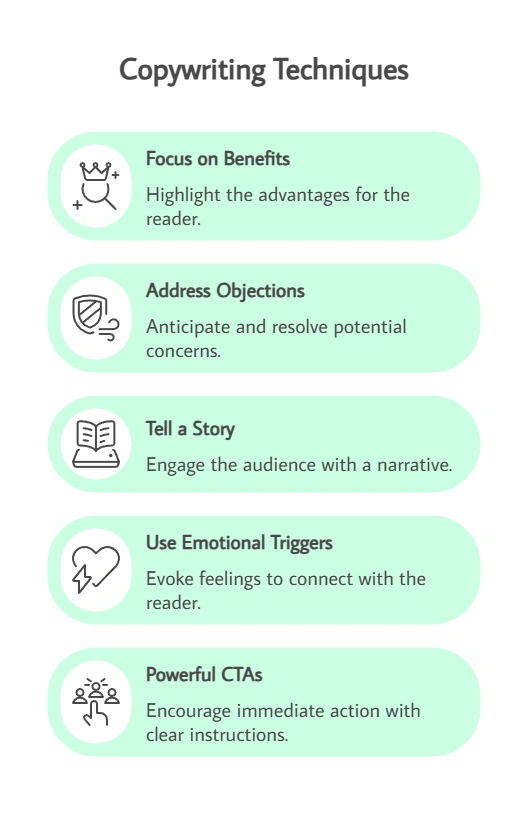
Here are five copywriting techniques to keep you on track.
1. Focus on Benefits
Features describe what your product does. Benefits explain how it improves your customer’s life or business.
In your copy, emphasise the tangible outcomes and value your product delivers.
Say you’re selling a SaaS product. Think about it like this:
- Feature – Advanced automation
- Benefits – Saves time and reduces errors
You might ask yourself, so what?
- Never work evenings or weekends again
You can keep drilling down with the “so what” question until you uncover the core motivation.
2. Address Objections Proactively
Objections are a natural part of the sales process. The dreaded:
Your offer sounds good, but…
You can overcome objections with the right approach. Addressing them early in the copy is your best bet.
This shows that you understand the customer’s concerns and builds trust in your solution.
Identify Common Objections
Before writing your copy, identify the most common objections your target audience may have. These could include concerns about:
- Time
- Price
- Trust
Understand these objections in advance. Why are they coming up?
Prepare responses to ease concerns and highlight the value of your offer.
Reframe Objections as Opportunities
Addressing objections also allows you to reframe them. Get your audience to think about the objections in a different light.
This helps you reframe objections as opportunities, showcasing the unique advantages of your product.
For example, say a potential buyer raises concerns about price.
Highlight the long-term return on investment and cost savings of choosing your solution.
3. Tell a Story
Stories make buying decisions easier. They let us see the world through someone else’s eyes.
You’re in a group standing on a hilltop 10,000 years ago, all gazing out over a vast valley. The whiff of damp moss wafts by on the breeze.
A forest looms on the horizon, a mist hangs over the treetops like a giant spider’s web and a wolf howls in the distance.
Your group wants to explore the forest. But what possible dangers lurk in the unknown? The potential risk breeds fear, stalls action.
Then, two brave souls offer to scout ahead and report back.
When they return, they tell a tale of unbounded resources, and the risk evaporates like mist on a sunny spring morning.
The decision to explore the forest becomes easier.
Weave stories into your copy to help mitigate risk for new customers. Testimonials are a perfect way to tell a success story.
Existing customers are the scouts who headed out into the unknown. They took the risk on your product and can now mitigate the risk for others.
- Turn their experiences into stories
- Let people see your business through their eyes
- Allay the fear of stepping into the dark
4. Use Emotional Triggers
Emotions play a significant role in decision-making, including buying decisions.
Up to 95% of our buying decisions are subconscious, driven by emotions rather than logic.
Identify the emotional triggers that motivate your target audience. Incorporate these into your copy.
Common emotional triggers include:
- Fear of missing out (FOMO)
- Desire for success
- Need for recognition
- Avoidance of pain points
Tap into these emotions, create a stronger connection with your potential buyers and increase the chances of a sale.
5. Use Powerful Calls to Action (CTAs)
Scarcity and urgency are useful for writing powerful CTAs. These persuasion techniques often motivate potential buyers to take action.
Limited availability or time-sensitive opportunities encourage prospects to act quickly. Otherwise, they might miss out (you’re tapping into FOMO, too).
Limited Time Offers
Use limited-time offers or promotions to create a sense of urgency. This might include discounts or bonus features for a specific period.
Exclusive Access
Offer exclusive access to your product or service to a select group of customers. This could involve:
- An invitation-only beta program
- A personalised experience
- A VIP membership
Powerful CTAs help convince people to take immediate action and buy your product.
Conclusion
Convincing someone to buy your product isn’t about clever tricks or manipulation.
Genuinely understand your audience, communicate real value and remove friction from the decision. Then, buying becomes the natural next step.
Instead of forcing a decision, you’re helping someone see that your product solves a real problem they already care about. The principles of persuasion simply give structure to that process. They help you show up as credible, trustworthy and worth listening to.
The best copy respects the reader, because it comes from understanding them. It answers their questions and addresses their doubts, making the outcome feel achievable.
If your product can genuinely help, don’t try to convince harder. Instead, explain better. You’ll earn the yes.